
Nearly 9 out of 10 construction projects experience budget overruns, with rework from scope gaps alone accounting for 5 to 12% of total project costs. For homeowners and commercial property owners evaluating proposals, that statistic is not just alarming. It is a direct consequence of one overlooked document: the project scope. Most people focus on the bottom-line price when reviewing contractor proposals, but the scope is where the real story lives. This article explains exactly what project scope means in construction, how it is developed, and how you can use it to make smarter, more confident decisions before signing anything.
Table of Contents
- What is project scope? Definitions and key concepts
- How project scope is developed and managed
- Project scope vs. product scope vs. statement of work: What's the difference?
- The risks of unclear scope: Scope creep, budget overruns, and dispute prevention
- Scope in action: Reading proposals, edge cases, and practical owner tips
- Expert perspective: Why clear scope is your best investment
- Get support and clarity for your next project
- Frequently asked questions
Key Takeaways
| Point | Details |
|---|---|
| Clear scope prevents headaches | Precise project scope reduces cost overruns and prevents disputes in construction. |
| Know what to look for | A good proposal’s scope outlines deliverables, exclusions, milestones, and change order steps. |
| Invest time upfront | Careful review of project scope and asking questions helps avoid surprises and extra costs. |
| Expert help pays off | Professional support for scope definition can lead to substantial savings and smoother projects. |
What is project scope? Definitions and key concepts
Project scope is the foundation of every construction proposal. Without a clear understanding of it, comparing bids becomes guesswork. Project scope is the defined boundary of work to be performed, including deliverables, exclusions, and the specific requirements needed to deliver a product with agreed features and quality. In plain terms, it answers the question: what exactly are we paying for, and what is not included?
For homeowners and property owners, this matters enormously. Two contractors may quote the same job at very different prices, not because one is cheaper but because they are quoting different scopes. Without reading the scope carefully, you cannot make an apples-to-apples comparison.
A well-written scope of work (SOW) typically includes the following components:
- Work description: A clear narrative of what work will be performed
- Deliverables: The specific outputs or completed items the contractor will hand over
- Exclusions: What is explicitly not included in the contract
- Assumptions and constraints: Conditions the contractor assumes are true (e.g., existing walls are structurally sound)
- Milestones: Key completion points or phases in the project
- Quality standards: The materials, codes, or performance benchmarks that apply
- Change order process: How changes to scope are formally requested and priced
According to scope management research, these components form the backbone of any reliable SOW. Each one protects both parties.
The distinction between deliverables and exclusions is especially important. Deliverables are what you will receive: a framed and drywalled bathroom addition, for example. Exclusions are what you will not receive: painting, plumbing fixtures, or permit fees may all be excluded unless explicitly listed. A proposal that looks complete may actually leave significant work unaddressed.
Key insight: If a proposal does not clearly list exclusions, treat every unlisted item as a potential extra cost. Ask the contractor to confirm in writing what is and is not included.
Reviewing scope components side by side across multiple proposals is the most reliable way to identify gaps before a project starts. It is also how you protect your budget.
How project scope is developed and managed
Knowing what belongs in a project scope is only part of the picture. Understanding how professionals define and control scope helps you recognize whether a contractor is following a structured process or improvising.
The Project Management Institute (PMI), through its PMBOK framework, defines project scope management as a six-step process:
- Plan scope management: Establish how scope will be defined, validated, and controlled
- Collect requirements: Gather all owner needs, regulatory requirements, and design specifications
- Define scope: Write the detailed project scope statement based on collected requirements
- Create the Work Breakdown Structure (WBS): Break the full scope into smaller, manageable work packages
- Validate scope: Formally confirm that completed deliverables meet the agreed scope
- Control scope: Monitor and manage changes to prevent unauthorized scope additions
The Work Breakdown Structure, or WBS, is a particularly useful tool for owners. It takes the full project and divides it into phases or categories, such as site preparation, foundation, framing, mechanical, and finishes. Each category is then broken into specific tasks. This structure makes it much easier to spot what is missing when you review a proposal.

Pro Tip: Ask your contractor to provide a WBS or phased task list alongside their proposal. If they cannot produce one, it may indicate that their scope definition process is less structured than it should be.
Formal scope control mechanisms are equally important. These include change order procedures, written approvals for any work additions, and regular scope reviews during construction. Projects that skip these steps tend to accumulate unauthorized additions that inflate costs over time.
A structured approach to scope management is a signal of contractor professionalism. It also gives you, as the owner, a clear framework for holding contractors accountable throughout the project.
Project scope vs. product scope vs. statement of work: What's the difference?
These three terms appear frequently in construction proposals and contracts. They are related but not interchangeable. Confusing them can lead to misaligned expectations and costly disputes.
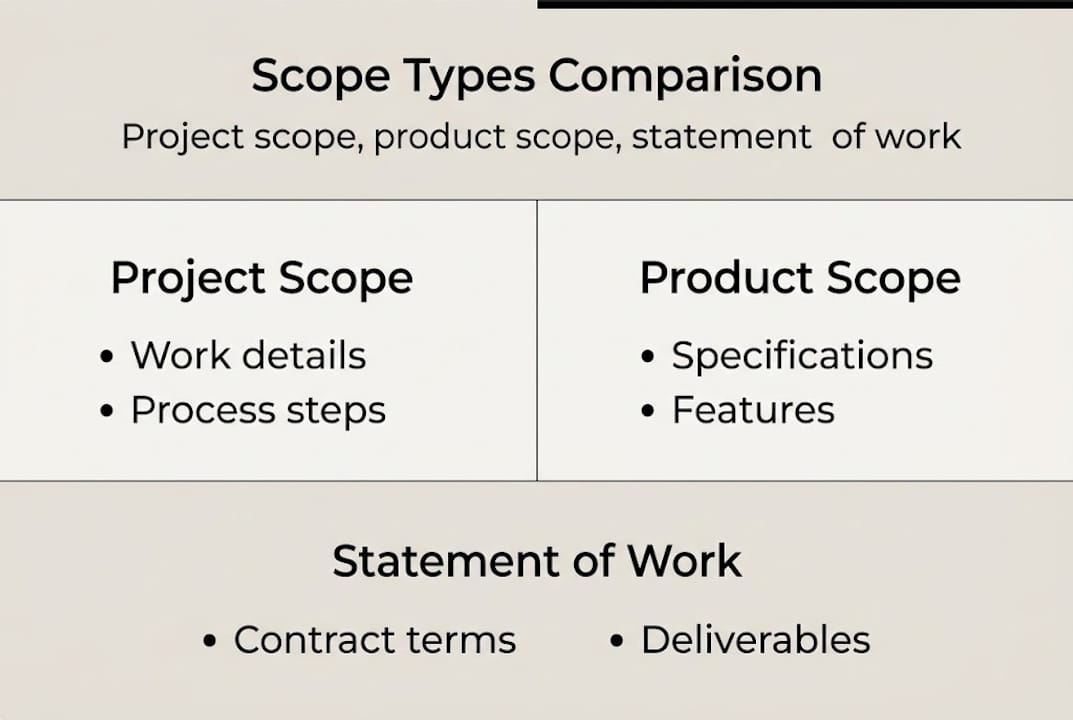
Project scope, product scope, and SOW each serve a distinct purpose. Here is how they compare:
| Term | What it defines | Where you see it |
|---|---|---|
| Project scope | The work and processes needed to deliver the result | Proposal, contract, project plan |
| Product scope | The features, specifications, and characteristics of what gets built | Design drawings, specifications |
| Statement of work (SOW) | Detailed task-level description of what the contractor will do | Subcontractor agreements, bid documents |
To make this concrete, consider building a detached garage. The product scope defines what the garage will look like: dimensions, door type, roofing material, insulation level. The project scope defines the work required to build it: excavation, foundation, framing, roofing, electrical rough-in. The SOW goes further, specifying which subcontractor handles which tasks, what materials are used, and in what sequence.
Why does this matter when evaluating bids? Because a contractor may quote based on a minimal product scope while leaving significant project scope items undefined. You may think you are getting a complete garage, but the SOW excludes the electrical panel, the concrete apron, or the permit fees.
Key questions to ask when reviewing proposals:
- Does the SOW align with the product specifications in the drawings?
- Are there tasks listed in the product scope that are missing from the project scope?
- Are any items described as allowances rather than fixed prices, and if so, are those allowances realistic?
Understanding the relationship between these three documents gives you a much stronger position when comparing contractor proposals side by side.
The risks of unclear scope: Scope creep, budget overruns, and dispute prevention
Scope creep is one of the most common and costly problems in construction. It happens when the project gradually expands beyond its original boundaries, often without formal approval or pricing adjustments. Poorly defined scope is the leading driver of scope creep, and PMI identifies scope changes as a top cause of project failure.
The numbers are sobering. Construction projects overrun budgets at a rate of 85 to 98%, with average overruns ranging from 28 to 80%. Rework caused by scope gaps accounts for 5 to 12% of total project costs. These are not edge cases. They are industry norms.
The good news is that clear scope documentation significantly reduces these risks. Precise scoping reduces change orders by 40 to 60% and disputes by 65 to 70%. Top-performing projects save up to 30% on costs through disciplined scope definition.
| Risk factor | Impact without clear scope | Impact with clear scope |
|---|---|---|
| Change orders | Frequent, uncontrolled | Reduced by 40 to 60% |
| Disputes | Common, expensive | Reduced by 65 to 70% |
| Budget overruns | 28 to 80% average | Significantly lower |
| Rework costs | 5 to 12% of total cost | Minimized |
For owners, the practical takeaway is this: do not wait for a dispute to arise before reviewing the scope. Build scope review into your process before you sign.
Pro Tip: Insist on a formal change control process in your contract. Every change to scope, no matter how small, should be documented in writing with an agreed price before work begins.
Remember: Verbal agreements about scope changes are extremely difficult to enforce. Written change orders protect both you and your contractor.
Asking contractors to clarify ambiguous scope language before signing is not a sign of distrust. It is sound project management. The clearer the scope, the fewer surprises during construction.
Scope in action: Reading proposals, edge cases, and practical owner tips
Reviewing a construction proposal with scope in mind requires a structured approach. Knowing what to look for, and what questions to ask, can save you significant time and money.
Construction SOW documents often include edge cases that are easy to overlook. Fixed-price contracts lock in a specific cost for defined work. Allowance-based contracts set a budget for items not yet fully specified, such as tile selection or light fixtures. Performance specifications define the outcome required (e.g., the wall must achieve R-19 insulation value), while prescriptive specifications define the exact materials to use (e.g., R-19 fiberglass batt, 6-inch depth). Trade interfaces, such as who is responsible for mechanical, electrical, and plumbing backing, are another common gap. Owner-furnished items, meaning materials or equipment you supply, must also be clearly identified.
Here is what to review in every proposal:
- Scope completeness: Does the SOW cover every phase of the project, from site prep to final cleanup?
- Exclusions list: Are exclusions clearly stated, or are they vague and open to interpretation?
- Allowances: Are allowance amounts realistic based on current material costs?
- Trade responsibilities: Is it clear which contractor handles each trade interface?
- Owner-furnished items: Are your responsibilities clearly defined to avoid delays?
Pro Tip: When comparing multiple proposals, create a simple checklist of scope items and mark which contractor includes each one. This is the fastest way to identify gaps and make a true apples-to-apples comparison.
Critical questions to ask before signing:
- What happens if site conditions differ from what was assumed?
- How are allowance overruns handled?
- Who is responsible for coordinating between trades?
Taking the time to ask these questions upfront is far less costly than resolving disputes mid-project.
Expert perspective: Why clear scope is your best investment
Most owners spend considerable energy searching for the lowest bid. Far fewer invest equivalent effort in reviewing the scope behind that bid. That is a costly oversight.
In our experience at ClearScope Solutions, the proposals that cause the most problems are rarely the most expensive ones. They are the ones with the vaguest scope language. An owner who accepts a low bid with an incomplete SOW often ends up paying more in change orders and rework than they would have with a higher, well-defined bid from the start.
Precise scoping reduces change orders by 40 to 60% and disputes by 65 to 70%. That is not a marginal improvement. It is a fundamental shift in project outcomes. Yet scope review remains one of the most undervalued steps in the owner's decision process.
The contrarian view is this: the time you spend reviewing and clarifying scope before a project starts is worth more than any discount you negotiate on the contract price. A clear scope is not just a document. It is your primary risk management tool.
Get support and clarity for your next project
Understanding project scope is one thing. Applying that knowledge across multiple competing proposals, each written differently, is another challenge entirely.
At ClearScope Solutions, we specialize in helping homeowners and commercial property owners make sense of complex construction proposals. Our construction consulting services include a thorough scope gap review, side-by-side contractor quote comparison, and practical recommendations that give you clarity and confidence before you commit. Whether you are evaluating a single proposal or comparing five bids, we help you identify what is missing, what is risky, and what represents genuine value. Explore how we focus on building confidence in construction decisions and take the next step toward a well-scoped, well-managed project.
Frequently asked questions
What does a project scope include in a construction proposal?
A construction project scope includes a description of the work, deliverables, exclusions, assumptions, milestones, quality standards, and a change order process. These components form the foundation of any reliable SOW and protect both the owner and the contractor.
Why is project scope so important in construction?
Clear project scope prevents overruns, disputes, and costly rework by setting expectations for all parties from the start. With 9 in 10 projects experiencing overruns and poorly defined scope identified as a leading cause of failure, the stakes are significant.
How can owners reduce the risk of scope creep?
Owners can reduce scope creep by insisting on detailed documentation, using formal change control, and asking clarifying questions before approving the project scope. The PMI PMBOK framework includes a dedicated Control Scope process for exactly this purpose.
What is the difference between project scope and product scope?
Project scope defines the work and boundaries required to complete the project, while product scope details the final features or specifications of what will be built. Understanding both is essential when evaluating whether a contractor's proposal fully covers what you expect to receive.