
Receiving three contractor proposals for the same project and realizing they look nothing alike is one of the most disorienting moments in any construction project. One quote bundles everything together, another itemizes every nail, and a third is suspiciously low with almost no detail. Choosing wrong can mean budget overruns, legal disputes, or work that needs to be redone entirely. A systematic approach to comparing proposals protects you from these outcomes. This guide gives you a practical, step-by-step checklist to evaluate contractor bids side by side, identify scope gaps, and make a confident, informed decision.
Table of Contents
- Preparing for proposal comparisons
- Step-by-step checklist for evaluating contractor proposals
- Contract review and legal protections
- Troubleshooting proposal comparison mistakes
- Our expert perspective: What most property owners miss
- Take your next step to confident construction decisions
- Frequently asked questions
Key Takeaways
| Point | Details |
|---|---|
| Gather multiple proposals | Always collect bids from at least three contractors to compare quality and cost effectively. |
| Use a scoring checklist | Apply a systematic checklist and weighted scoring to evaluate each proposal with confidence. |
| Verify legal coverage | Check contracts for strong legal protections, including cancellation and payment milestones. |
| Avoid common mistakes | Double-check references, credentials, and hidden fees to prevent costly surprises. |
| Seek expert guidance | Consult experienced advisors for complex decisions to maximize project success. |
Preparing for proposal comparisons
With the project goals set, it's crucial to prepare properly before comparing proposals. Preparation is not just about collecting paperwork. It's about creating the conditions for a true apples-to-apples comparison, where every contractor is responding to the same requirements.
Start by collecting at least three proposals. Fewer than three gives you limited perspective on market pricing and contractor quality. More than five can become unmanageable. Three to four qualified bids is the practical sweet spot for most residential and commercial projects.
Before sending out your request for proposals, document your project requirements clearly. This means specifying materials, finishes, timelines, and any technical standards that apply. When every contractor bids against the same scope, you can evaluate differences in price and methodology rather than wondering why the numbers don't match.
Next, build your pre-screening checklist. Before any proposal reaches your evaluation table, each contractor should meet these baseline criteria:
- Valid contractor's license for your state and project type
- General liability insurance and workers' compensation coverage
- No unresolved complaints with your state licensing board
- A portfolio of similar completed projects
- Willingness to provide references from recent work
References deserve more attention than most property owners give them. A strong systematic proposal review process always includes reference checks. When you call references, ask specifically about project management, communication quality, how problems were handled, and whether the project finished on time and on budget. According to best practices for hiring qualified contractors, you should call at least three recent clients from similar projects and assess safety records, including a contractor's Total Recordable Incident Rate (TRIR), which measures workplace injuries per 100 workers per year. A TRIR below the industry average signals a safety-conscious operation.
Financial stability is another pre-screening factor that gets overlooked. A contractor who is overextended on other projects may not have the resources to staff yours properly.
| Pre-screening factor | What to verify |
|---|---|
| License | Active, correct trade category |
| Insurance | GL and workers' comp certificates |
| References | 3 recent, similar project contacts |
| Safety record | TRIR below industry average |
| Financial stability | No liens or unresolved judgments |
Pro Tip: Request all proposals in the same format. Provide a simple template with line items for labor, materials, permits, contingency, and timeline. This single step eliminates most apples-to-oranges confusion before it starts.
Step-by-step checklist for evaluating contractor proposals
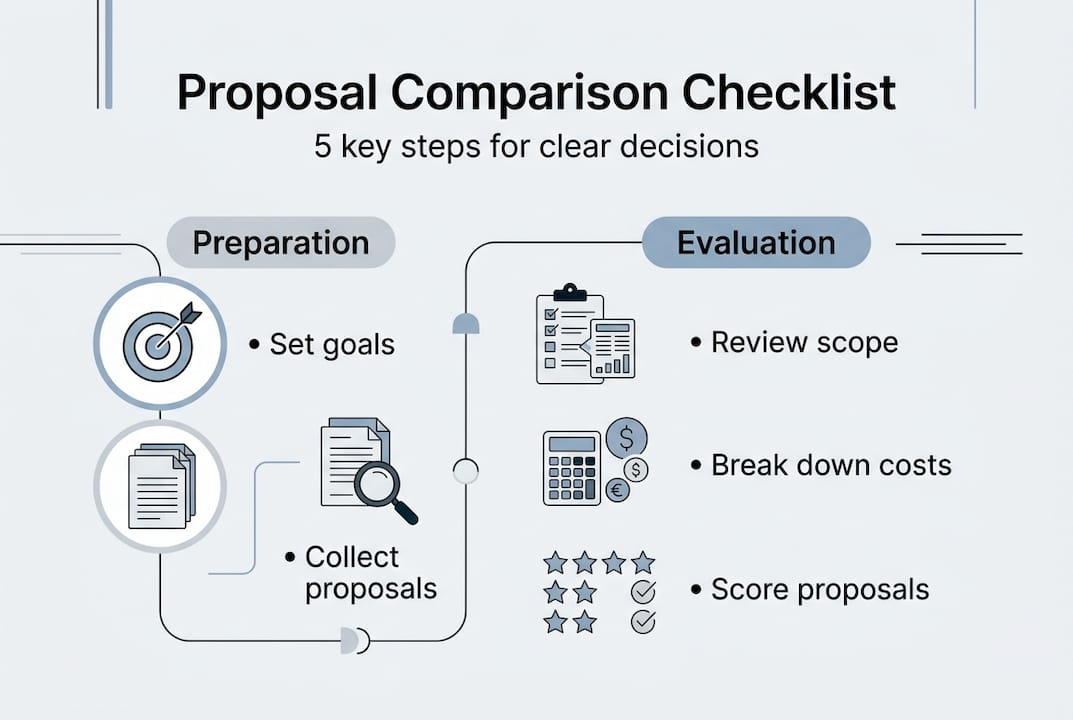
Once all proposals are collected, follow these steps to evaluate them systematically.
Step 1: Confirm the scope of work. Every proposal should describe exactly what will be done, what materials will be used, and what is explicitly excluded. Missing scope items are where budget surprises hide.

Step 2: Break down cost elements. Separate labor, materials, equipment, permits, and overhead. A low total price that bundles everything together is a red flag. You cannot evaluate what you cannot see.
Step 3: Review the project timeline. Assess whether the proposed schedule is realistic. An unusually fast timeline may indicate shortcuts. An unusually long one may reflect poor resource planning.
Step 4: Evaluate contractor methodology. How does each contractor plan to manage the work? What quality control processes do they use? For commercial projects, comparing construction quotes must also include a review of MEP (mechanical, electrical, and plumbing) coordination plans and contingency strategies.
Step 5: Apply a weighted scoring system. Not all criteria carry equal weight. Price matters, but so does experience, safety, and communication. Research on bid evaluation criteria recommends weighting price at 40 to 60 percent of the total score for commercial projects, with experience and methodology accounting for 20 to 30 percent each.
| Evaluation criterion | Suggested weight | What to assess |
|---|---|---|
| Price and cost breakdown | 40 to 60% | Transparency, completeness |
| Experience and past performance | 20 to 30% | Similar projects, references |
| Methodology and schedule | 10 to 20% | Realism, quality protocols |
| Safety and compliance | 5 to 10% | TRIR, insurance, permits |
Pro Tip: Score each proposal independently before comparing totals. This prevents the lowest price from anchoring your judgment before you've assessed everything else.
For commercial projects specifically, pay close attention to contingency planning. A contractor who accounts for unknowns in their bid is being honest. One who doesn't is either inexperienced or setting you up for change orders later.
Contract review and legal protections
After scoring the proposals, it's vital to examine the contracts offered by each contractor. The proposal tells you what a contractor plans to do. The contract defines what they are legally obligated to do.
A well-structured contract protects both parties. Weak contracts create ambiguity, and ambiguity in construction almost always costs money. When reviewing contracts, look for these essential elements:
- A detailed scope of work (SOW) that matches the proposal exactly
- Milestone-based payment schedule tied to verified project progress
- Clear cancellation rights and the process for exercising them
- A dispute resolution clause specifying mediation or arbitration
- Permit responsibility clearly assigned to the contractor
- Warranty terms for both labor and materials
On the legal side, many states require written contracts for projects above a certain value. In California, for example, a written contract is legally required for any home improvement job over $500. Even where it is not required, a written contract is always the right choice.
A thorough review of contract review tips will confirm that vague language is one of the most common sources of construction disputes. Phrases like "as needed," "standard materials," or "work to be determined" have no place in a binding agreement.
"Review the contract for legal protections: cancellation rights, dispute resolution, a detailed scope of work, and milestone payments. Reject vague terms or any suggestion to skip permits." Evaluating bids from general contractors
If a contractor suggests skipping permits to save time or money, walk away. Unpermitted work can void your homeowner's insurance, create liability during resale, and require costly demolition and rework to bring into compliance.
Milestone payments are worth special attention. Avoid contracts that require large upfront payments before any work begins. A reasonable deposit is 10 to 15 percent. Payments should follow verified progress, not a calendar date.
Troubleshooting proposal comparison mistakes
Even with a systematic checklist, certain mistakes can slip through the cracks if you're not careful. Knowing where property owners most often go wrong helps you stay on track.
Skipping reference checks. This is the single most common mistake. A contractor's past performance is the most reliable predictor of future behavior. Verifying recent clients means contacting at least two recent clients directly and confirming their experience, not just reading online reviews. Also verify credentials through your state licensing board.
Missing hidden fees. Some proposals look competitive until you read the fine print. Watch for exclusions buried in footnotes, allowances that are set unrealistically low, and language that gives the contractor broad authority to issue change orders. These are common ways a low bid becomes an expensive project.
Failing to verify credentials. A license number on a proposal is not the same as a valid, active license. Look up every contractor's license status directly through your state's licensing board website before signing anything.
Here are the most common avoiding proposal pitfalls mistakes to watch for:
- Choosing the lowest bid without understanding why it is lower
- Accepting verbal promises that are not written into the contract
- Ignoring safety record discrepancies between contractors
- Overlooking payment schedule terms that favor the contractor
- Failing to clarify who is responsible for subcontractor management
Pro Tip: Create a simple side-by-side comparison spreadsheet with every line item from each proposal. When one contractor includes something the others don't, that's a scope gap worth investigating.
"The lowest bid is not always the best value. A proposal that excludes key scope items or carries vague terms can cost far more than a higher bid that covers everything clearly."
Dispute resolution processes are another overlooked area. If a disagreement arises mid-project, knowing in advance whether you'll go to mediation, arbitration, or court saves time and money. Confirm this is addressed in every contract before you sign.
Our expert perspective: What most property owners miss
Bringing these steps together, it's valuable to reflect on what experience reveals about proposal comparisons. The most consistent pattern we see at ClearScope Solutions is property owners who focus almost entirely on price, then feel blindsided when the project doesn't go as expected.
Price is one input, not the conclusion. A contractor with a higher bid who clearly articulates their methodology, carries strong references, and presents a realistic schedule is often the lower-risk choice. Risk has a cost too, even when it doesn't show up on the initial quote.
Weighted scoring matters because it forces you to quantify what you actually value. When you assign numbers to experience, safety, communication, and methodology, the decision becomes clearer and less emotional.
Schedule realism is one of the most underrated factors. An aggressive timeline that cannot be supported by the contractor's current workload or crew size will result in delays, and delays cost money. Transparent communication about realistic timelines is a sign of a trustworthy contractor.
For complex projects, expert construction guidance from an independent advisor removes the uncertainty from this process. A third-party review adds objectivity that is difficult to maintain when you are personally invested in the outcome.
Take your next step to confident construction decisions
When you're ready to apply these strategies, the right advisory partner can make all the difference.
At ClearScope Solutions, we specialize in helping homeowners and commercial property owners make sense of contractor proposals. Our construction consulting services include scope gap reviews, apples-to-apples proposal comparisons, contract assessments, and risk evaluations. We review every proposal with objectivity and deliver clear, practical recommendations.
If you are evaluating bids for an upcoming project and want structured support, our service focused on building confidence in construction decisions is designed exactly for this moment. ClearScope Solutions is here to guide you from confusion to clarity, so you can choose the right contractor with confidence.
Frequently asked questions
What should I look for in a contractor proposal?
Focus on a detailed scope of work, transparent cost breakdowns, payment terms, contractor credentials, and verifiable references. Strong proposals also include safety records and project history from similar projects.
How many proposals should I compare before choosing a contractor?
Compare at least three qualified proposals to get a reliable picture of market pricing and contractor quality. Fewer than three limits your perspective and makes it harder to identify outliers.
What legal protections should be included in a construction contract?
Every contract should include cancellation rights, a dispute resolution clause, a detailed scope of work, and milestone payment terms tied to verified progress.
How do commercial proposal evaluations differ from residential?
Commercial evaluations place greater emphasis on methodology, MEP coordination, contingency planning, and schedule realism. Weighted evaluation criteria typically assign price 40 to 60 percent of the score, with experience and methodology carrying significant weight alongside it.