
Choosing the wrong construction vendor is one of the most expensive mistakes a property owner can make. Costs spiral, timelines stretch, and the stress compounds quickly. Yet most hiring decisions still come down to a gut feeling or the lowest number on a page. This guide walks you through a proven, step-by-step process for comparing contractor proposals side by side, so you can evaluate each bid on merit, spot red flags early, and make a confident, well-informed decision. Whether you are managing a home renovation or a large commercial build, a structured comparison process protects your investment from the start.
Table of Contents
- Define your project scope and prepare bid requests
- Vet contractor licenses, insurance, and credentials
- Compare proposals using best-value criteria
- Review contracts, negotiate terms, and monitor execution
- Why best-value beats low-bid: rethinking construction vendor selection
- Build with confidence: get expert help for your next project
- Frequently asked questions
Key Takeaways
| Point | Details |
|---|---|
| Standardize bid requests | Always provide detailed scopes and request 3-5 itemized bids to compare fairly. |
| Verify credentials | Check every vendor's license, insurance, and bonding to reduce your project risk. |
| Use best-value scoring | Don't default to the cheapest bid—apply weighted criteria to balance price, experience, and skills. |
| Secure thorough contracts | Insist on clear terms to avoid disputes and keep your project on track. |
Define your project scope and prepare bid requests
A fair comparison starts long before the first contractor walks through your door. If every vendor is bidding on a slightly different version of your project, you are not comparing proposals. You are comparing guesses. That is why standardizing project scope before soliciting any bids is the single most important step in the process.
Your project scope document should include the following:
- Architectural drawings and specifications: Provide the same set to every bidder.
- Material standards: Specify grades, brands, or acceptable equivalents where relevant.
- Timeline expectations: State your target start and completion dates clearly.
- Responsibility boundaries: Clarify who handles permits, inspections, site cleanup, and utility coordination.
- Exclusions: Note anything that is explicitly out of scope to prevent assumptions.
With a complete scope document in hand, you are ready to solicit bids. Solicit 3 to 5 detailed, itemized bids from licensed contractors using identical project scope descriptions. Fewer than three bids limits your perspective. More than five creates comparison fatigue and rarely adds meaningful new information.
Pro Tip: Send your scope document as a PDF with a cover sheet that lists submission requirements, a deadline, and a contact for clarifying questions. This signals professionalism and filters out vendors who are not serious.
Use the table below as a starting checklist when preparing your bid package:
| Document or item | Purpose | Required from all bidders |
|---|---|---|
| Project drawings | Ensures uniform scope understanding | Yes |
| Material specifications | Prevents substitution surprises | Yes |
| Timeline requirements | Sets scheduling expectations | Yes |
| Insurance certificate request | Confirms coverage before work begins | Yes |
| Itemized cost breakdown | Allows line-by-line comparison | Yes |
| References list | Supports vendor vetting | Yes |
When every contractor bids on the same document, you get a genuine apples-to-apples comparison. That consistency is the foundation of every reliable vendor selection process.
Vet contractor licenses, insurance, and credentials
With your bid requests out, it is critical to ensure that every vendor in the running is legitimate and protected. A polished proposal means nothing if the contractor behind it is unlicensed or uninsured. One incident on an uninsured job site can expose you to serious financial and legal liability.
Here is what to verify contractor credentials for every bidder:
- State contractor license: Check the license number against your state's contractor licensing database. Confirm it is active and covers the type of work being performed.
- General liability insurance: Request a certificate of insurance naming you as an additional insured. Minimum coverage levels vary by project size.
- Workers' compensation insurance: Required in most states when a contractor employs workers. Gaps here put you at risk if a worker is injured on your property.
- Surety bond: A bond protects you if the contractor fails to complete the work or defaults. For federally funded projects exceeding $100,000, bonding is mandated under the Miller Act.
Unlicensed contractors pose high risk. Verifying licenses, insurance, and bonds via state databases and certificates is not optional. It is the minimum standard for responsible vendor selection.
Beyond documentation, watch for these red flags during initial conversations:
- Requests for large upfront deposits before work begins
- Reluctance to provide written contracts or references
- No physical business address or verifiable history
- Pressure to decide immediately
Pro Tip: Limit your initial deposit to no more than 10% of the total project cost, with a maximum of $1,000 on smaller jobs. Legitimate contractors do not need large sums before a single nail is driven.
Vetting credentials takes an hour or two per vendor. That time investment can save you from months of disputes and financial loss.

Compare proposals using best-value criteria
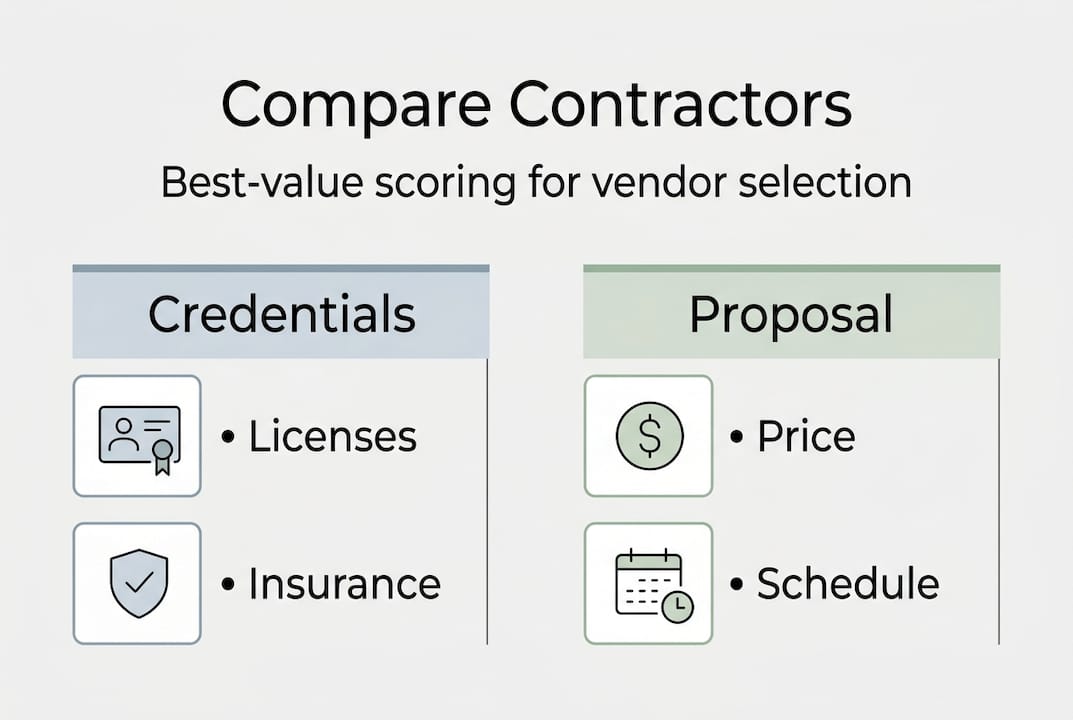
Once you have screened for legitimacy, it is time to put the proposals side by side and analyze them with a scoring framework. The most common mistake at this stage is selecting based on price alone. A low number feels safe. It rarely is.
Bids that are 30% or more below the average of competing proposals are a warning sign, not a bargain. They often signal missing scope, inferior materials, or a contractor who plans to recover margin through change orders later. The best-value weighting method distributes your evaluation across three criteria: price at 35 to 40%, experience and past performance at 30%, and technical approach at 25%.
Here is how to apply a simple scoring system:
- Set your criteria weights before reviewing any bids to avoid bias.
- Score each contractor from 1 to 10 on each criterion.
- Multiply each score by its weight to get a weighted score.
- Add the weighted scores for a total value score per contractor.
- Review outliers before making a final decision, especially any bid that scores unusually high or low on a single criterion.
The table below illustrates how this works in practice:
| Criterion | Weight | Contractor A | Contractor B | Contractor C |
|---|---|---|---|---|
| Price | 35% | 8 (2.80) | 10 (3.50) | 6 (2.10) |
| Experience | 30% | 9 (2.70) | 6 (1.80) | 8 (2.40) |
| Technical approach | 25% | 8 (2.00) | 5 (1.25) | 9 (2.25) |
| References | 10% | 9 (0.90) | 7 (0.70) | 8 (0.80) |
| Total score | 8.40 | 7.25 | 7.55 |
In this example, Contractor A delivers the best overall value even though Contractor B has the lowest price. This is exactly the kind of insight that assessing contractor qualifications objectively can reveal. A scoring framework removes emotion from the process and gives you a defensible basis for your decision.
Review contracts, negotiate terms, and monitor execution
Comparison complete. Now, ensure that your winning contractor delivers as promised by locking down a solid contract. Most construction disputes do not start on the job site. They start in a poorly written agreement that left too much open to interpretation.
Design-build contracts reduce project timelines by 30% and budgets by 15 to 20% compared to traditional delivery methods, largely because they reduce ambiguity and align responsibilities early. The lesson applies broadly: clear contracts prevent most problems.
Every construction contract should include these essential clauses:
- Detailed scope of work: Match it precisely to the bid documents.
- Change order process: Define how changes are requested, priced, and approved in writing.
- Payment schedule: Tie payments to completed milestones, not calendar dates.
- Substantial completion definition: Specify what done actually means.
- Dispute resolution: Include a clear process, such as mediation before litigation.
- Warranty terms: Confirm what is covered, for how long, and by whom.
Pro Tip: Never release a progress payment without a corresponding site inspection confirming the milestone is complete. Payment tied to verified progress protects you from funding work that has not happened yet.
Use the table below to track contract execution milestones:
| Milestone | Completion criteria | Payment trigger | Verified by |
|---|---|---|---|
| Site preparation | Cleared and graded to spec | 10% of contract | Owner or consultant |
| Foundation complete | Inspected and approved | 20% of contract | Licensed inspector |
| Framing complete | Structural review passed | 20% of contract | Owner or consultant |
| Mechanical rough-in | Permits signed off | 15% of contract | Licensed inspector |
| Substantial completion | Punch list agreed | 30% of contract | Owner or consultant |
| Final closeout | All items resolved | 5% of contract | Owner |
Managing contract execution with this level of structure keeps both parties accountable and reduces the risk of disputes at every stage.
Why best-value beats low-bid: rethinking construction vendor selection
Here is the uncomfortable truth about low-bid selection: it is a habit built on the illusion of control. Choosing the lowest number feels decisive. It feels fiscally responsible. But in construction, it often just defers the real cost to a later, more painful moment.
Public sector procurement has grappled with this for decades. The Brooks Act, which governs federal architect and engineer selection, prohibits price-based selection entirely for professional services. It requires qualifications-based selection because experience shows that vendor selection philosophies focused purely on price produce worse outcomes over the life of a project.
Private owners do not have the same legal framework, but the lesson still applies. A contractor who wins on price alone has no margin for quality. When something unexpected happens, and it always does in construction, that contractor has no buffer. The cost lands on you through change orders, delays, or rework.
Weighted best-value scoring is not just a procurement tool. It is a risk management strategy. It forces you to define what matters before you are influenced by a number on a page. Experience, technical approach, and references carry real weight in predicting project success. Price matters, but it is one input among several, not the final word.
The property owners who consistently get good construction outcomes are the ones who treat vendor selection as a strategic decision, not a transaction.
Build with confidence: get expert help for your next project
Navigating contractor proposals, credentials, and contract terms takes time and expertise that most property owners do not have on hand. That is exactly where professional support makes a measurable difference.

At ClearScope Solutions, we specialize in helping homeowners and commercial property owners conduct a rigorous contractor quotes comparison. We review each proposal side by side, identify scope gaps and exclusions, assess risk, and deliver clear recommendations so you can choose with confidence. If you want to strengthen your decision-making process, explore our consulting services or learn more about building confidence in construction decisions. We are here to make the process clearer, faster, and less stressful for you.
Frequently asked questions
How many contractor bids should I get for a construction project?
Collect 3 to 5 itemized bids using identical project scope descriptions. This range gives you enough perspective for a reliable comparison without creating unnecessary complexity.
What credentials should I ask to see from a construction vendor?
Request active licenses, general liability and workers' compensation insurance, and project-appropriate bonds. Verify each credential through your state's licensing database and ask for certificates of insurance naming you as an additional insured.
Should I always pick the lowest construction bid?
No. Bids 30% or more below average often signal missing scope or planned change orders. A weighted best-value scoring approach gives you a more reliable basis for selection than price alone.
What clauses are essential in a construction contract?
Include scope of work, a defined change order process, a milestone-based payment schedule, substantial completion criteria, and dispute resolution terms. Poor contracts cause most disputes, so invest time in getting these details right before work begins.