
Managing a property portfolio is rarely as simple as finding the lowest bid and hoping for the best. Many property managers still rely on gut instinct, informal referrals, or basic price comparisons when selecting contractors and handling risk. That approach leaves serious gaps. Unvetted contractors create liability exposure, surprise repair costs, and compliance failures that erode your bottom line. Expert consulting brings a structured, data-driven framework to contractor evaluation and risk assessment, replacing reactive firefighting with predictive, measurable processes. This guide walks through exactly how consultants add operational value, what methodologies they use, and what measurable results you can expect.
Table of Contents
- Why property managers need expert consulting
- Consultants' methods for contractor evaluation
- Risk assessment: Turning uncertainty into actionable plans
- Consultant-driven methodologies for operational efficiency
- Case studies: The measurable results of consulting
- Perspective: What most property managers overlook about consulting
- Discover how consulting can transform your operations
- Frequently asked questions
Key Takeaways
| Point | Details |
|---|---|
| Structured risk management | Consultants transform risk assessment into systematic, proactive processes that reduce liability. |
| Better contractor vetting | Expert-guided evaluations prevent hidden costs and legal issues from unqualified vendors. |
| Data-driven efficiency gains | Consultants implement dashboards and audits that reveal and solve costly inefficiencies. |
| ROI-backed improvements | Property managers report up to 77% savings and higher asset performance after consulting. |
Why property managers need expert consulting
Property management is a discipline where small process failures compound quickly. One uninsured subcontractor, one missed inspection, or one poorly scoped maintenance contract can trigger legal disputes, regulatory fines, or costly emergency repairs. Most of these problems are preventable with the right systems in place.
The challenge is that in-house teams are often stretched thin. They manage tenant relations, lease renewals, accounting, and compliance simultaneously. Contractor vetting and risk management tend to get handled informally, relying on whoever is available rather than a repeatable process. This creates inconsistency and exposure.
Here are the clearest signals that it is time to bring in outside expertise:
- Maintenance costs are rising without a clear explanation
- Contractor disputes or callbacks are frequent
- Your team lacks a standardized vendor qualification process
- Insurance claims are increasing year over year
- You are scaling your portfolio and current workflows are not keeping pace
Consultants bring specialized frameworks that address these gaps directly. They assess vendor relationships, identify process redundancies, and establish risk controls that your in-house team can maintain long-term. As noted in vendor vetting best practices, structured consulting shifts property ops from reactive to predictive, preventing costly emergencies.
"The difference between a well-run portfolio and a struggling one often comes down to process discipline, not property quality."
The downstream benefits are concrete: fewer legal disputes, better maintenance outcomes, stronger vendor accountability, and improved return on investment across your portfolio.
Pro Tip: Before engaging a consultant, document your current contractor onboarding steps in writing. Even a rough list will help the consultant identify your biggest process gaps faster and reduce your engagement time.
Consultants' methods for contractor evaluation
Having recognized the value of consulting, let's explore what consultants actually do for contractor evaluation. The process is far more rigorous than most in-house teams apply, and the structure is what makes it reliable.
A standard consultant-led contractor evaluation process includes the following steps:
- License verification confirming the contractor holds a current, valid license for your state and trade category
- Insurance checks reviewing general liability and workers' compensation certificates with your entity listed as an additional insured
- Reference audits contacting past clients to assess quality, timeliness, and dispute history
- Performance benchmarking comparing the contractor's pricing and scope against market standards
- IRS classification review ensuring independent contractor status is correctly documented to avoid misclassification liability
The contrast between in-house and consultant-led vetting is significant:
| Evaluation area | In-house approach | Consultant-led approach |
|---|---|---|
| License check | Occasional, informal | Verified against state database |
| Insurance review | Certificate on file | Coverage limits confirmed, entity listed |
| Reference check | One or two calls | Structured audit with scoring |
| Pricing benchmark | Lowest bid wins | Market-rate comparison across trades |
| Risk classification | Rarely reviewed | IRS criteria applied formally |
Unlicensed contractors represent a specific and serious liability. In many states, property owners who knowingly hire unlicensed contractors can be held liable for injuries, code violations, and work defects. Consultants flag these risks before contracts are signed, not after damage is done.
As structured vetting processes show, consultants assist property managers through license verification, insurance checks, reference audits, and performance benchmarking to ensure compliant contractor selection.
Pro Tip: Always maintain at least two qualified vendors per trade category. Single-vendor dependency creates concentration risk. If your only plumber is unavailable during an emergency, you are forced into unvetted, expensive alternatives.
Risk assessment: Turning uncertainty into actionable plans
A robust contractor process is half the equation. Addressing risk is equally essential to lasting property performance. Consultants approach risk assessment through a four-stage cycle that transforms uncertainty into structured action.

The four stages are: identify, assess, mitigate, and monitor. Each stage builds on the last, creating a living risk management system rather than a one-time audit.
Common risks consultants address across property portfolios include:
- Legal risks: Lease disputes, fair housing violations, contractor misclassification
- Financial risks: Unexpected capital expenditures, underinsured losses, deferred maintenance costs
- Operational risks: Vendor failures, staffing gaps, workflow breakdowns
- Physical risks: Structural deficiencies, code violations, deferred inspections
Mitigation tactics are matched to each risk category. Legal risks are addressed through standardized lease language and contractor agreements. Financial risks are managed through reserve fund planning and insurance transfer strategies. Operational risks are reduced through vendor redundancy and documented escalation procedures. Physical risks are handled through scheduled preventive inspections.
The return on this investment is measurable. Property risk management data shows that risk assessment cycles involving identification, assessment, mitigation, and monitoring consistently reduce vacancy rates, improve compliance scores, and can deliver returns of up to 231% through reduced risk exposure and operational improvement.
Key stat: Outsourcing risk management and operational consulting can yield up to a 231% ROI through reduced vacancies and proactive risk controls.
The monitoring stage is where many in-house programs fall short. Risks are identified but never tracked over time. Consultants establish dashboard-based monitoring so that emerging risks are caught early, before they become expensive problems.
Consultant-driven methodologies for operational efficiency
Effective risk and contractor management often rely on operational discipline and measurement tools. Here is how consultants provide these advantages through structured methodologies.
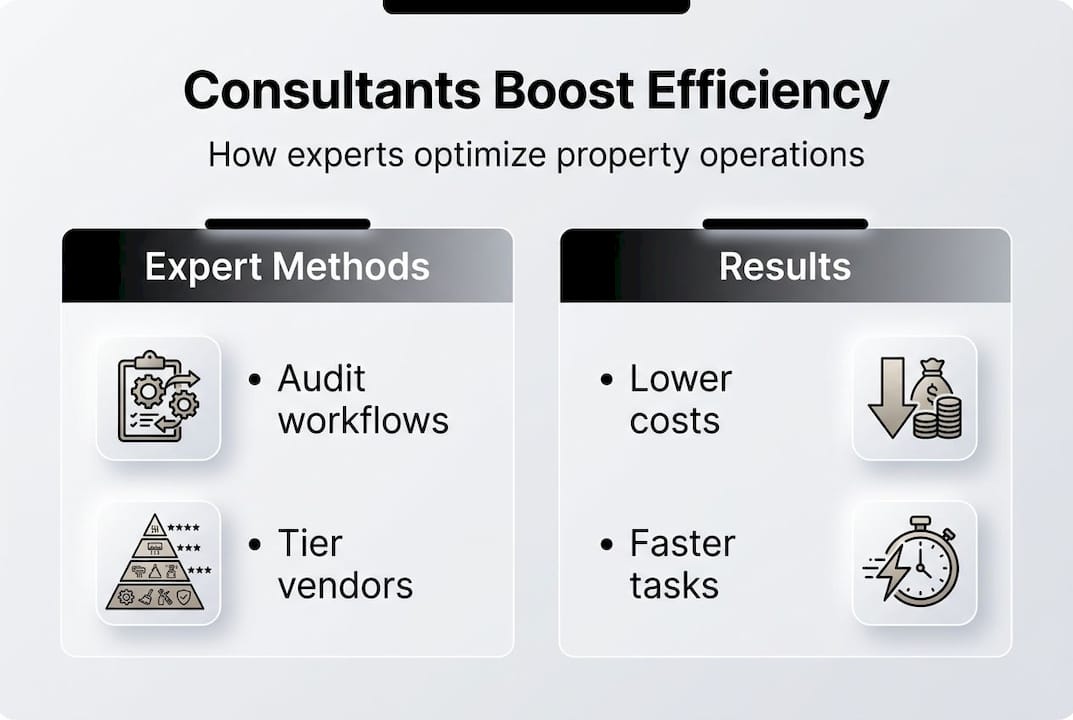
Workflow audits are typically the starting point. A consultant maps your current processes from tenant request to work order completion, identifying bottlenecks, redundant approvals, and communication gaps. These audits often reveal that 20 to 30 percent of staff time is spent on tasks that could be automated or eliminated. Operational efficiency consulting methodologies include workflow audits, vendor tiering, preventive maintenance scheduling, and data-driven dashboards for KPI tracking.
Vendor tiering is a particularly underused strategy. Rather than treating all approved vendors equally, consultants segment them into strategic partners and standard approved vendors. Strategic partners receive longer contracts, priority dispatch, and joint performance reviews. Standard vendors are used for routine work with standard terms. This distinction improves service quality and gives you negotiating leverage.
Preventive maintenance scheduling is another core tool. Consultants build maintenance calendars tied to asset age, warranty terms, and inspection cycles. This reduces emergency repair costs significantly. Improving operational efficiency through scheduled maintenance is one of the highest-return activities a property manager can implement.
Here is what a consultant-driven operational framework typically includes:
- Workflow audit with bottleneck identification
- Vendor tier classification and contract templates
- Preventive maintenance calendar by asset type
- KPI dashboard covering response times, cost per unit, and vendor performance scores
- Automation recommendations for work order routing and tenant communications
"You cannot improve what you do not measure. KPI dashboards turn anecdotal performance into accountable data."
For property managers looking to scale, operational audits for property management provide the baseline data needed to make confident investment and staffing decisions.
Pro Tip: Start with three core KPIs before building a full dashboard: average work order completion time, maintenance cost per unit per year, and vendor callback rate. These three metrics reveal the most about operational health.
Case studies: The measurable results of consulting
Now let's look at the real-world business impact consultants deliver, including substantial financial improvements that show up directly on the bottom line.
The numbers across the industry are consistent. Property managers who engage consultants for operational and contractor improvements typically see:
- Maintenance cost reductions of 30 to 77 percent through preventive scheduling and vendor renegotiation
- Emergency repair frequency reduced by up to 40 percent within the first year
- Vendor contract savings averaging 15 to 25 percent through competitive benchmarking
- Compliance-related fines and legal costs reduced significantly through standardized documentation
For a portfolio of 1,000 units, these gains translate to millions in savings. A 30 percent reduction in maintenance costs on a portfolio spending $400 per unit annually yields $120,000 in year-one savings. Scale that with reduced vacancy and improved lease renewal rates, and the ROI compounds quickly.
Property management cost benchmarks confirm that staff costs run $180 to $280 per unit per year for residential properties, and outsourcing operational consulting yields up to a 231% ROI through reduced vacancies and risk management.
Smaller portfolios also benefit. A 50-unit operator who engages a consultant for a focused vendor audit and process review often recovers the consulting fee within the first quarter through renegotiated contracts and reduced callbacks. The key is matching the scope of the engagement to the size and complexity of the portfolio.
The pattern is clear: consulting is not an overhead cost. It is a revenue protection and efficiency investment with measurable, trackable returns.
Perspective: What most property managers overlook about consulting
Here is what most conversations about consulting miss. The value is not just in the deliverables, it is in the shift from reactive to predictive management. Most property managers who resist consulting do so because they believe their current systems are "good enough." But good enough is a moving target in a regulatory environment that keeps tightening.
The hidden cost of manual, ad-hoc contractor management is rarely calculated honestly. Every callback, every disputed invoice, every emergency repair carries a labor cost, a relationship cost, and an opportunity cost. These do not show up as line items, so they get ignored.
Small portfolios often assume consulting is only for large operators. That is a costly misconception. A single consulting engagement that tightens your vendor contracts and standardizes your risk documentation can pay for itself many times over, regardless of portfolio size.
The uncomfortable truth is that most cost-saving shortcuts in property management end up more expensive over a three-year horizon. Skipping proper vetting saves an hour today and costs thousands in disputes next year. Structured consulting, as explored through property management insights, moves you from managing problems to preventing them.
Discover how consulting can transform your operations
If the patterns above reflect challenges you are navigating right now, the next step is straightforward. ClearScope Solutions works directly with property managers to evaluate contractor proposals, identify scope gaps, assess risk, and deliver clear, actionable recommendations.
Our approach is built around objectivity. We review proposals side by side, flag missing scope and exclusions, and give you the structured analysis needed to make confident decisions. Whether you are managing a single commercial property or a growing residential portfolio, our consulting services overview provides a clear path forward. Start with building confidence in construction decisions and see how structured consulting translates directly into operational results.
Frequently asked questions
What are the key benefits of hiring consultants for property management?
Consultants help streamline contractor vetting, reduce legal risks, and boost operational efficiency. Consulting delivers measurable ROI through expert methodologies including risk reduction and vacancy management.
How do consultants evaluate contractors for property managers?
Consultants use structured processes including license checks, insurance verification, reference audits, and performance benchmarking. This structured vetting ensures compliant, qualified contractor selection at every stage.
What risk management techniques do consultants use in property management?
Consultants identify and assess legal, financial, and operational risks, then implement mitigation strategies like standardized leases and insurance requirements. This four-stage risk cycle keeps risk management active and current.
Do small property portfolios benefit from consulting?
Yes. Even brief consulting engagements improve compliance and process rigor for smaller operators. Small portfolios gain efficiency and risk controls that more than offset the consulting investment.